
Intellectual Intelligence and Artificial Property: Mix-ups Ahead
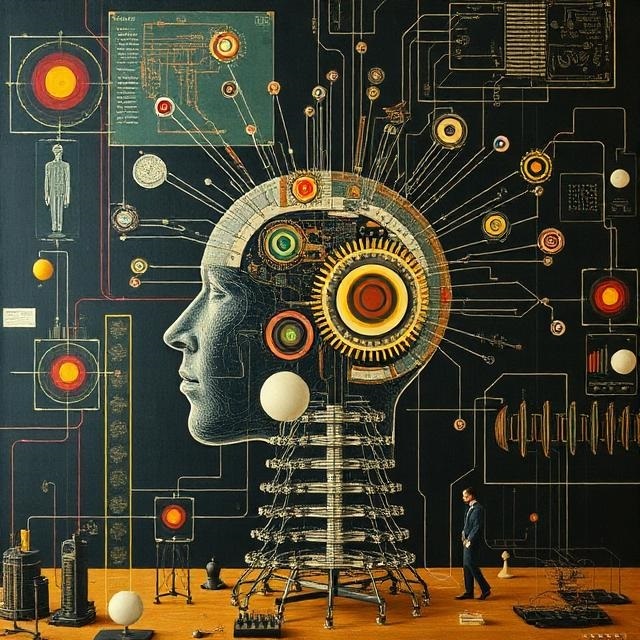
If you generate an image using OpenAI’s DALL-E, say by using a prompt to illustrate a concept as if painted by Marcel Duchamp (something that renders really well by the way!), who does it belong to? You? OpenAI? Can you even claim ownership of it? If you can, can an AI model legally use your AI-assisted artwork as training material? What if it is for scientific or non-profit use? Or simply used to derive broader trends without outputting your work? And more philosophically yet, how do we balance innovation with fairness here?
The advent of generative AI raises several intellectual property questions that courts, legislators and stakeholders are actively trying to sort out. Aren’t you curious to know how Europe or Asia view creativity in art in the age of AI? Whether North America is more developer or rightholder-friendly? How Latin America is playing its cards? When algorithms output the same images whether they’re run in Namibia or Kazakhstan, or anywhere else really, the international scale is worth considering. Especially because AI’s global nature warrants concerns around broader coherence across countries’ copyright frameworks, where legal uncertainty can be collectively costly.
Drawing from CEIMIA’s unique report Copyright and AI, from its Comparative Framework for AI Regulatory Policy series —first of its kind to closely study how 20 jurisdictions are tackling AI and IP’s intersection— the reader is first introduced to some central notions of the current AI and copyright debate and then provided an overview of the world’s response to these bottlenecks. This country overview is detailed across two legislative axes chosen to map a country’s position: infringement in AI training, and copyrightability of AI-generated works – both translating key cultural stances towards innovation, private property and human creativity.
How to sound like an AI & IP pro
Infringement in AI training
Generative AI models are trained on enormous amounts of text, images, and audio, among other types of data, typically scraped from the web. This training data could include, say, a famous artist’s song or painting; which means… yes, you guessed it, that they could be copyrighted! Meaning only the author can say who has the legal right to use their work (whether it is printing, publishing, performing, etc.). Now we have a problem… There’s a clash, as we say, an infringement. Is it fair that an AI model uses your beloved artwork as training material after it simply scraped it online? Perhaps not. At the same time, doesn’t it allow for higher-quality training, and more innovation in GenAI? Not all countries treat this clash the same way. As shown in our report, the overall trend is toward cautiousness with AI training performed on copyrighted data but with differing approaches on specific exceptions: AI training for research, fair use (commenting, criticizing or parodying) or text and data mining (when AI looks through huge volumes of data to spot patterns and trends a human couldn’t see). Overall, most jurisdictions are increasingly wary, something also well reflected by the growing legal complexity analysed in this work.
Copyrightability of AI-generated works
If you generate a song, or an image with AI, does that make you an artist? More of legal importance, is your creation copyrightable? Do you automatically get full exclusive rights over it? Authorship and ownership? Is it fair to grant protection to an artwork generated with a single prompt when artists spend months working on a piece? On the other hand, couldn’t it allow for more innovative art styles, some we haven’t even discovered yet? That’s yet another big challenge in the field that countries have to handle. There is a growing uncertainty on the boundaries of copyrightability for AI outputs globally, with debates in particular around the degree of human contribution needed for legal protection – for example, whether a quick prompt is enough, or extensive iterations and directions are needed.
How’s everybody legislating today?
Nosy algorithms
On the infringement side, varying legal frameworks worldwide have significant implications for international cooperation, market attractiveness, regulatory interoperability, and the future of copyright law in general. Specifically, countries’ take on text and data mining (TDM) differ a lot: some provide generous exceptions while others adopt more conditional or opt-out-based models.
In the permissive, developer-friendly clan, China offers a broad, innovation-oriented legal framework with limited right-holder control. So does the US, although it remains embroiled in debates over whether fair use (excluding commercial purposes) or other exceptions apply to training, especially when training sets are scraped (i.e. copied from website data) from copyrighted content. Japan explicitly allows AI training if the output isn’t directly consumed by humans for enjoyment. Israel also favors a permissive approach recognizing extensive exceptions for many uses (strongly relying on fair use); and Singapore has introduced a computational data analysis exception that may allow AI training on copyrighted materials, although applicability is uncertain.
Now on the right-holder-friendly team, the EU has a strong moral tradition of human-centered creativity, with well-established legal certainty, allowing TDM exceptions for research and commercial purposes and offering rightholders to opt-out of commercial TDM. However, these exceptions are variably implemented at the national level (eg. infringement wasn’t a thing in Germany until a recent case ruling). The UK has TDM exceptions for non-commercial research; Canada launched public consultations looking to promote innovation while preserving creators’ rights; and Ukraine only allows narrow TDM exceptions limited to scientific publications.
A glance at South America now shows Brazil making a rare attempt in its draft AI legislation to introduce a right of remuneration for copyright holders while Chile is among the few Latin American countries with a draft AI bill directly addressing TDM with exceptions for non-commercial purposes, provided there is sufficient transparency.
Should we expect an AI Renaissance?
On copyrightability of AI-generated works now, we won’t keep you in suspense any longer: there is a broad consensus that no fully autonomous AI output can be copyrighted; human involvement is necessary. However, jurisdictions interpret the threshold of human contribution differently: how much the creator needs to prompt, select or edit an output for it to get protection.
Which countries seem most enthusiastic about AI artists? Well, China provides a flexible approach, valuing the human interaction with the AI; Japan provides a detailed analysis of human input needed such as prompts, number of attempts, output selection and post-generation modifications; the UK potentially recognises authorship to the person who made the necessary arrangements; and last but not least, Ukraine, with a unique law giving full copyright to humans who create AI works.
Now, more cautious approaches of artificial creativity include the US which proves to be strict when detailing what can be protected based on the evidence of the prompt: creators must provide “sufficient original expression” and clearly disclose the role of AI in their creations. In Chile, the lack of clarity on the subject reflects its cautious approach, despite an active national AI strategy which may influence future developments.
A quick glance at Asia this time shows a Japan where copyright may apply to hybrid works with demonstrable human creative input, a South Korea with ongoing legal discussions indicating a need for clearer guidance in the area and a Singapore that grants copyright only if a human selects one of multiple AI-generated works.
Towards globally harmonized digital ownership?
China and the US have radically different visions of human creativity in the AI age, Japan and the UK legislated very differently on infringement on AI training but, hey! There is an ideal world in this fragmented landscape where we all speak the same AI and copyright language. Public and private stakeholders are actively participating in the debate to solve growing challenges brought by AI’s irruption on IP’s international terrain.
First off, legal fragmentation brings uncertainty. It can make enforcing legitimate rights difficult where protections are weaker, or hinder fair participation in jurisdictions where protections are overly rigid or unclear. Lack of cohesion also brings compliance burdens, increased international transaction costs, market fragmentation for AI providers whose models are trained across datasets that have been sourced globally or stifle innovation by inhibiting cross-border collaboration. Hopefully we can steer away from these challenges.
Countries are debating, building, and refining their laws to accommodate copyright’s old planet in the AI era. But their mission in the coming years, potentially yet more importantly than developing their respective legal frameworks, will be to achieve regulatory interoperability whereby they foster coordination and avoid duplicating efforts.